
Mark Sesum Marketing That Works

    Why I'm A World Class Marketer - Better Than McDonalds, KFC, & Coca Cola...

    By Mark Sesum |

    I'm a better marketer than the world's biggest brands. Better than Coca Cola, McDonalds, KFC.

    Better than anything the UK has to offer. Cadburys? Asda? Walkers?

    I'm better than all of them.

    Seriously, bear with me.

    The reason I'm better than all the global super agencies, creating mainstream campaigns for the world's biggest brands, is because I learned marketing by spending my own money, while under pressure to get results for my own business.

    That genuinely made me a world class marketer.

    This is because the bigger a business gets, the less effective it's marketing is.

    A businesses like Coca Cola simply couldn't do direct response marketing. The corporate, legal & accounting teams would kill it at the first opportunity.

    If you look back at the origin stories of most of these businesses, a world class marketer or salesman was involved. Go research the back stories of Ray Kroc or Colonel Sanders. Kroc was a career salesman of pretty much anything he could get his hands on.

    In his 60's, Colonel Sanders was sleeping in his car, travelling across America to sell his chicken recipe & the earliest KFC franchises.

    They don't do that now.

    McDonald's marketing amounts to a few whistleable jingles and meaningless taglines. KFC have committed to spending literally billions on new logos and fonts.
    Marketing Illustration

    Take away the corporate advertising and marketing world, and the veneer of mysticism that they apply to make this stuff credible, and it all amounts to something that a 5 year old kid could have done as a school project.

    Think I'm joking? I'm not.

    Think about it. What would a 5 year old do if you told them to create a marketing campaign for Coca Cola?

    'Daddy... I've drawn a polar bear drinking a can of Coke'.

    Everyone in the mainstream advertising world thinks that the Christmas Coca Cola ads are genius. They think that putting Santa on a Coke truck, with yet another catchy jingle playing in the background is marketing 'genius'.

    Can they tell you how many sales Coca Cola made directly attributed to those ads? No.

    Because they don't think in those terms, because it's not their business, and it's not their money on the table.

    That same concept could have been created in less than a day by any competent marketer working with a halfway decent jingle writer.

    It's the billions of pounds of media ad slots that puts it on our screens.

    Think of the brands I mentioned above.

    A gorilla playing drums. A random shopper slapping the change in her back pocket. Leicester's most famous footballer in random scenarios.

    None of this is 'genius'. It's not even difficult.

    It was the strength of these brands that made the ads relevant.

    The mainstream marketing industry thinks it was the other way around.

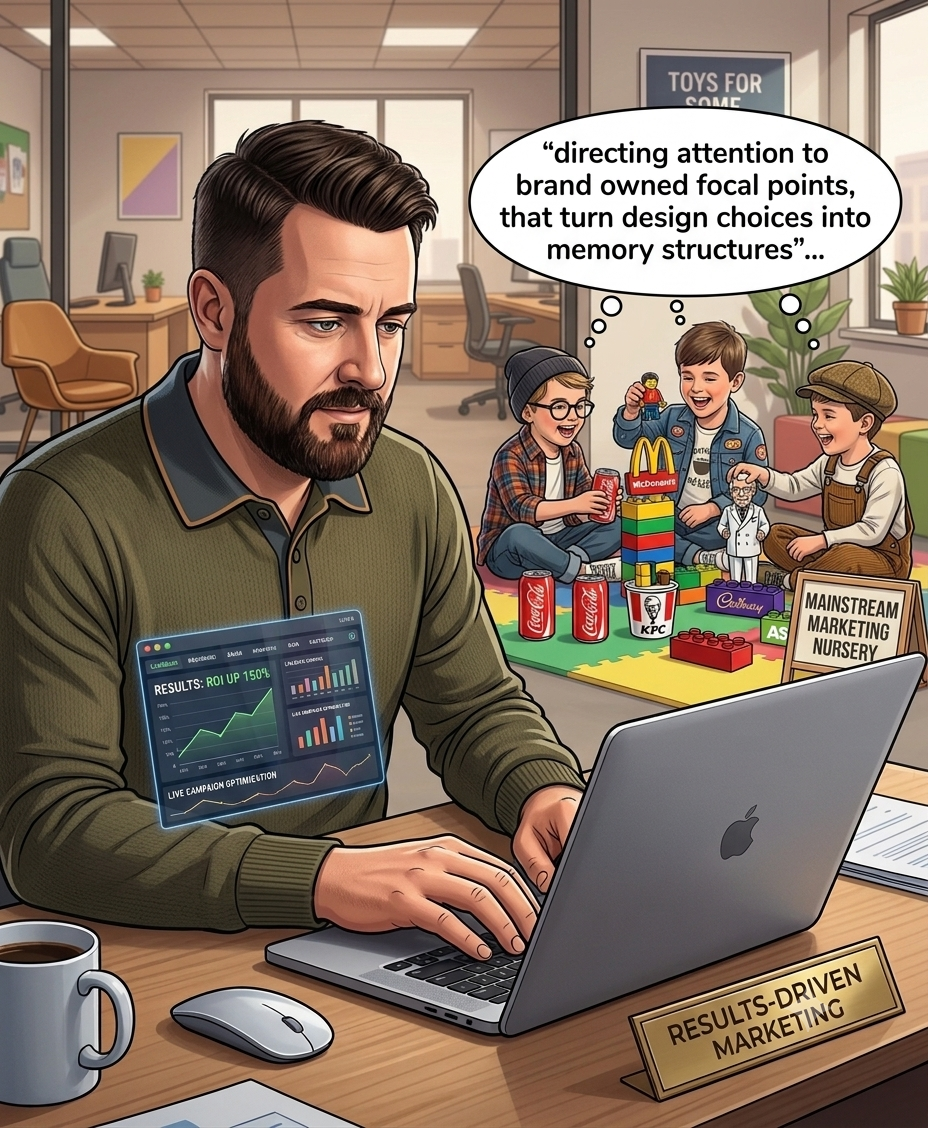
    KFC's recent re-brand had them all giddy & excited about the latest opportunity to babble a load of rubbish on Linkedin... sorry, 'create content'... talking about the effects of 2D visuals vs 3D ones -

    'directing attention to brand owned focal points, that turn design choices into memory structures'...

    That's a direct quote. I didn't make that up.

    The success of these huge, global businesses isn't down to some BS peddling Madison Avenue or Shoreditch based agency, full of hipster marketing grads.

    (Take this sincerely because I mean it - as a rule of thumb, take a marketing degree and a background in a big organisation as a sign of incompetence, not competence.)

    The success of these businesses was built by the founders & early pioneers, who had to get results.

    The way they market & advertise now pretty much has to be vanilla, because it has to be inoffensive & uncontroversial to the mainstream.

    The remaining 99% of businesses however, can't afford to be mainstream.

    They don't have a billion quid to push ads out. Every pound spent has to show a return. It has to leave, do its thing, and then come back in the form of revenue with additional pounds attached in profit.

    Most mainstream marketers don't even consider this to be their job.

    I consider it my ONLY job. That's what makes me world class.
    McDonalds Crackdown On Franchisees Over Pricing Blunders. Industry Insiders Not Impressed. They're Wrong - Here's Why...

    By Mark Sesum |

    Did you know that McDonalds don’t set the prices in their franchised restaurants, the franchisees do.

    Technically, you could walk (or drive!) into several McDonalds and they could all have different pricing.

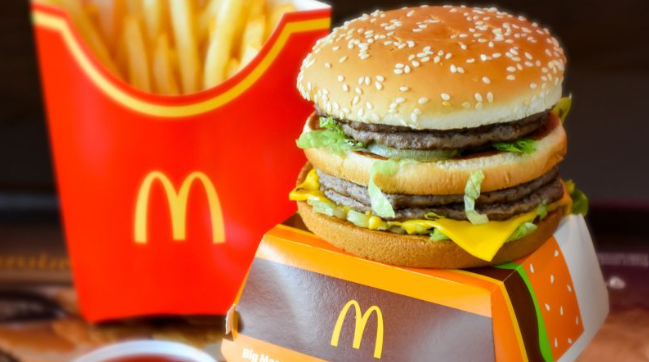
    McDonalds Burger and Fries

    I suspect that the reasoning behind this approach is that they want the franchisee to operate as independently as possible, while applying their local market knowledge.

    However, McDonalds wants to see this independence reflected in performance.

    They want to see the most effective balance between pricing, and what the market will pay. Too cheap and you’re flushing profit down the toilet. Too expensive and you lose sales.

    The result, especially in population dense areas with multiple outlets, is that most franchisees are copying each other, and pricing becomes highly standardised anyway.

    But there have been the odd few getting it wrong, and McDonalds have come down on them hard, retaining and enforcing their right to dictate pricing if the franchisee can’t.

    Some people within franchising don’t like this. They think that McDonalds are strangling the very autonomy that they claim to want their franchisees to have as independent business owners.

    "How much of this is actually mine to run?" is the question that prospective McDonalds franchisees should be asking themselves, according to one commentator.

    He went on to cite examples of other franchises (which he referred to as ‘brands’ - see below), who allow their franchisees much more freedom and control.

    Here’s what he misses though, and what it teaches us about branding;

    Unlike the vast majority of franchised 'brands', the McDonalds brand ACTUALLY means something.

    I often wonder why people think that a ‘brand’ is a tangible thing that can be superficially ‘created’.

    Many think of a ‘brand’ as a logo, a colour scheme, or a punchy tagline. There is also currently a very odd and inaccurate trend of referring to businesses, of all shapes and sizes, as ‘brands’.

    As I’m constantly saying, a brand is NOT a business. Businesses HAVE brands. You can not start a ‘brand’, you start a BUSINESS, and then build the brand.

    What a brand actually is, as I’ve also said many times, is the reputation of your business. Or as I saw it very eloquently put recently, your brand is ‘accumulated trust’.

    You have to earn it. And McDonalds have spent multiple decades building that accumulated trust.

    So their franchisee's job effectively, becomes simply to see that everything runs smoothly and not screw up.

    That is not the case in other franchises. No matter how much they, or anyone else, calls them 'brands', the vast majority of the time, the value of their brand exists only in the heads of the people incentivised to believe in it.

    Eg - the people who are paid to sell it.

    In the marketplace, where customers live, it usually means squat.

    So because there is no brand value, the franchisee ACTUALLY has to build a business and a local brand from scratch.

    The only value that the franchise offers to the franchisee are the systems and the support. The ‘brand’ is usually of no value whatsoever.

    It is usually just a name and a logo. It doesn’t have decades of ‘accumulated trust’.

    So when talking about McDonalds relative to other franchises, you're talking apples and oranges.

    Pricing, like anything else, is strategy. It should be measured on performance. If franchisees get it wrong consistently, there is absolutely nothing wrong with McDonalds correcting, or even punishing them for it. As long as they're fair when doing so.

    Why Google's "Marketing Playground" Isn't Actually New Buying Behaviour. It Only Looks Like It is

    By Mark Sesum |

    There's a post doing the rounds about how the traditional marketing funnel is dead, replaced by something called the "marketing playground."

    Based on Google's research into how people actually buy, customers don't move neatly from ad to landing page to offer to sale anymore.

    Instead, they bounce around. They see your YouTube video here, then a social post there, a review, a live event, your website, all random, all chaotic, all building trust at their own pace until they get in touch when they're ready.

    It's a good description. I just don't think it's a new behaviour.

    Customers have NEVER moved neatly, from ad to landing page to offer to sale. It's a myth.

    This is what marketing has always done, with different tools.

    Customers needing multiple touch points before they buy isn't a 2026 phenomenon. It's what direct mail was doing decades before the internet existed, a leaflet here, a follow-up letter there, a catalogue, a phone call, all chipping away at trust until someone was ready to buy.

    Online re-marketing has been running the exact same playbook for years, just with pixels and ad platforms instead of envelopes and stamps.

    What's actually changed isn't buying behaviour. It's the environment and the tools.

    The "playground" feels chaotic because there are now a hundred more places for a customer to bump into you, not because customers have fundamentally rewired how they come to trust a business, or how they come to a buying decision.

    The average customer is indecisive and risk averse. They have always needed multiple nudges before converting, the nudges just used to come through the letterbox.

    And that's just the ones who DO convert. The vast majority don't.

    What has genuinely changed though, is saturation and fatigue.

    Where I think there's real substance is this: tech has lowered the barrier to entry so far that everyone is now playing the same game, and most are doing it badly.

    Every business is chasing the same attention in the same feeds, and usually doing it badly. Hype, sensationalism, clickbait. Many are putting out offers and lead magnets that simply don't align or resonate with their market, that's if they've even thought about target market at all.

    Let me tell you from experience: you REALLY think about these things when you have to shell out a few hundred quid in print and pay to get it through thousands of letterboxes.

    That makes you focus.

    When you can throw up dozens of posts on social media, send 'free' emails, you give it less thought, and the lazy, easy way to grab attention becomes click bait headlines and outlandish promises.

    The result is customers who are jaded. Good marketing and good offers have customers salivating, not jaded.

    They've been offered enough mediocre PDFs in exchange for their email, followed by enough generic spam, that they become desensitised.

    That's not a new buying psychology. That's market fatigue from too many businesses doing the same thing badly.

    Why the playground framing is still useful, even if it's not revolutionary.

    Here's where I'll give credit.

    Thinking in terms of a playground rather than a corridor is a genuinely useful mental shift for how you build content, even if the underlying customer behaviour isn't new.

    If you're still treating every piece of content as step two of a rigid three-step funnel or sequence, you're going to get frustrated when customers don't behave like that, because most of them never did.

    Building standalone pieces of value that someone can land on randomly and still get something from, that's just good practice regardless of what you call the model.

    But don't mistake a better way of describing the journey for a fundamentally different journey. The mechanics haven't changed.

    People still need to see you, trust you, and be offered the right thing at the right time, via the right message (and sometimes, via the right media) before they'll buy.

    The bit that actually matters.

    Whether you call it a funnel, a playground, or whatever, none of it replaces the fundamentals.

    Offer the right person the right solution, and it mostly doesn't matter how you sell it. Multiple touch points, content that stands on its own, re-marketing that catches people when they drift, all of that works.

    It worked through the post, it worked through email, and it works through whatever platform comes next.

    The tools will keep changing. The names for the model will keep changing. The thing that actually moves a sale, relevance, won't ever change.

    Page 1 of 2